
On Friday, July 14, India launched its ambitious third lunar mission Chandrayaan 3, eyeing a rare feat in moon exploration.
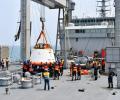
Nerves gave way to smiles at the spaceport in Sriharikota as delays and an anomaly-triggered 'hold' forced Indian Space Research Organisation (ISRO) scientists to revise the launch schedule of a test vehicle carrying payloads related to the country's ambitious human space flight mission, Gaganyaan which soared into skies after initial hiccups.
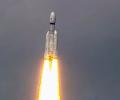
The Chandrayaan-3 mission that aims for a soft landing on the moon's surface, paving the way for future interplanetary missions, carries six payloads that would help ISRO understand the lunar soil and also get the blue planet's photographs from the lunar orbit.

'We started AgniKul to show that space transportation should be as simple as road transportation.'

Shifting the focus to its next space odyssey after successfully placing a lander on the moon's uncharted South Pole region, the Indian Space Research Organisation (ISRO) chief S Somanath on Saturday said that the country's maiden solar mission Aditya-L1 is ready and will be launched in the first week of September.
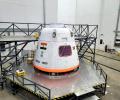
Modi gave these directions during a meeting to review the preparedness of the Gaganyaan mission and the first demonstration flight of the crew escape system test vehicle scheduled for October 21.

Somanath thanked all those who prayed for the mission's success, and ISRO veterans like A S Kiran Kumar , the space agency's former chief.

The primary satellite TeLEOS-2 is a synthetic aperture radar satellite developed under partnership between Defence Science and Technology Agency (DSTA) representing the Government of Singapore and ST Engineering.
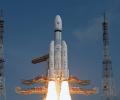
The mission is targeted for launch in the fourth quarter of 2024.

The test vehicle development flight (TV-D1) is aimed at testing the crew module that will carry Indian astronauts during the human spaceflight late next year.

While the mission is a follow-up to the PSLV-C55 TeLEOS-2 mission launched in April this year, scientists in Sunday's mission will place the fourth stage of the PSLV rocket in a lower orbit.

The rover will carry out in-situ chemical analysis of the lunar surface during the course of its mobility.

Scientists are working on conducting various tests for the ambitious Gaganyaan mission and the agency is coordinating with the Navy and others in this connection, he said.

The Lagrange point 1 (L1) of the Sun-Earth system is about 1.5 million km from the Earth. It is about one per cent of the total distance between the Earth and the Sun.

'Today onwards, the onboard thrusters will be fired and Chandryaan-3 will be taken away from Earth for an eventful landing on Moon's surface on August 23'
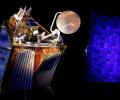
On Sunday, at 12.07 am in Sriharikota, off the coast of the Bay of Bengal, it was almost like an early Diwali, with the sky lit up by the launch of 36 OneWeb satellites. The Indian Space Research Organisation (Isro) did the launch on a 43.5-metre-tall Geosynchronous Satellite Launch Vehicle Mark III (GSLV Mk III) rocket. After the countdown, which started 24 hours in advance, once the mega screen marked the launch, a select group of invitees at the gallery cheered by applauding the feat.

The ISRO on Sunday scripted yet another history after its LVM3 rocket successfully placed 36 satellites of United Kingdom-based OneWeb group company into intended orbits.

Nag Panchami will be celebrated on August 2.
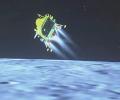
Despite the chill in bilateral ties, Pakistan's media on Thursday gave front-page coverage to India's historic moon landing while a former minister even called it a 'great moment' for Indian Space Research Organisation.

'ISRO Chairman Dr. Somanath's leadership truly created history and we extend our hearty congratulations to him and his team,' Venugopal said on X, formerly Twitter.

Announcing that the health of Chandrayaan-3's Lander Module is normal, ISRO on Friday said that the module has successfully undergone a deboosting (slowing down) operation, taking it closer to the Moon.

ISRO's first mission in 2023 and SSLV's sequel saw a strange coincidence--it was launched at 9.18 am, the same time its predecessor lifted off from the Satish Dhawan Space Centre here on August 7, 2022 but could not deliver due to orbit anomaly and flight path deviation.

Being driven to abandon Indian middle-class values, asks Ajit Balakrishnan.

Once deployed and operational, it will be used to support the satellite imagery requirements of various agencies within the government of Singapore.
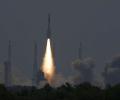
The Indian Space Research Organisation (ISRO) on Monday successfully launched a second generation navigation satellite, using a GSLV rocket with a cryogenic upper stage to do the job.
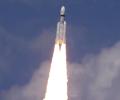
For the Gaganyaan programme, LVM3 rocket is re-configured to meet the human rating requirements and has been christened as 'Human Rated LVM3', ISRO said and it would be capable of launching the Orbital Module to an Low Earth Orbit of 400kms.

A visibly emotional Modi addressed scientists at the Indian Space Research organisation's command centre in Bengaluru, who were involved in the Chandrayaan-3 mission and lauded them for their efforts.
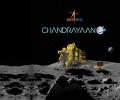
Sachin Tendulkar, Sania, Mirza, Anil Kumble and Virat Kohli hailed Moon mission Chandrayaan-3's successful landing
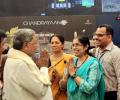
Even as the scientists and staff at Mission Operations Complex broke into applause, the core team members thanked all those who had worked on the mission. Quietly and without jingoistic boasting of their stupendous achievement. And that is the most remarkable aspect of ISRO -- they let their work do the talking, notes Minnie Vaid, author of Those Magnificent Women And Their Flying Machines, ISRO's Mission to Mars.

The entire process being autonomous when the lander has to fire its engines at the right times and altitudes, use the right amount of fuel, and scan of the lunar surface for any obstacles or hills or craters before finally touching down.
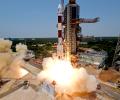
The successful launch of Aditya-L1 - the country's maiden mission to study the Sun - is expected to garner increased investor interest in the Indian space sector and trigger more funding for private players. Several private sector players, including Larsen & Toubro (L&T), MTAR Technologies, and Ananth Technologies, have played a pivotal role in the Indian Space Research Organisation's (Isro's) solar observatory mission. Aditya-L1 on Saturday set off on a 125-day journey on a PSLV-C57 rocket, in its attempt to study various elements relating to the nearest star from the halo orbit around Lagrange point 1 (L1) of the Sun-Earth system, which is about 1.5 million km from Earth.

ISRO Chairman S Somanath had recently said the most critical part of the landing will be the process of reducing the velocity of the lander from 30 km height to the final landing, and the ability to reorient the spacecraft from horizontal to vertical direction. "This is the trick we have to play here," he said.
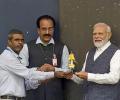
'Perhaps the government should explain how the same scientific temper, which authored a precise landing for Chandrayaan-3, finds the periodic table and the theory of evolution not good enough for inclusion in the educational curriculum,' asserts Shyam G Menon.

Lander Module of Chandrayaan-3 spacecraft comprising the lander and rover has successfully separated from the Propulsion Module, Indian Space Research Organisation said on Thursday.

The four astronauts are -- Prashanth Balakrishnan Nair, Angad Prathap, Ajit Krishnan, and Shubhanshu Shukla -- Modi said at the Vikram Sarabhai Space Centre (VSSC) at Thumba near the Kerala state capital.

Around 23 minutes after lift-off, the primary satellite got separated and it was followed by six other co-passenger satellites, which were deployed into the intended orbits sequentially, ISRO said.

The spacecraft will now prepare for separation of the lander module -- comprising the lander and rover -- from the propulsion module.
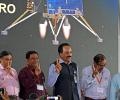
Ex-ISRO chairman G Madhavan Nair said the scientists at space agency have achieved this historic success by getting a salary one-fifth of the scientists in the developed world.
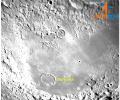
If any factor regarding the lander module appears unfavourable, then the landing will be shifted to August 27, said the Space Applications Centre-ISRO about Chandrayaan-3 on Monday.

After the successful deployment of Chandrayaan-3's lander and rover on the moon, Indian Space Research Organisation (ISRO) is hoping that their mission life will not be limited to one lunar day or 14 earth days, and that they will come back to life when the sun again rises on the Moon, to carry on with the experiments and studies there.
 © 2026 Rediff.com - Advertise with us - Disclaimer - Privacy Policy - Sitemap - Feedback - About us - Terms of use - Grievances